I redesign the parts of hospital care that frustrate everyone.
The clinic running forty minutes behind. The referral tracked across six spreadsheets. The safety event that gets reported and then goes quiet. I sit with the people doing the work, map what actually happens, test a change, and measure it long enough to know it held.
Before anything else I watch the work happen and ask the people doing it where the shortcuts are.
Not the policy version. The real one, drawn out, with the gaps and the rework visible.
A PDSA cycle small enough that staff will try it and honest enough to fail visibly.
Then the dashboard or scorecard that tells us weekly whether it held — usually one I build myself.
Digitalizing the kidney transplant referral pathway
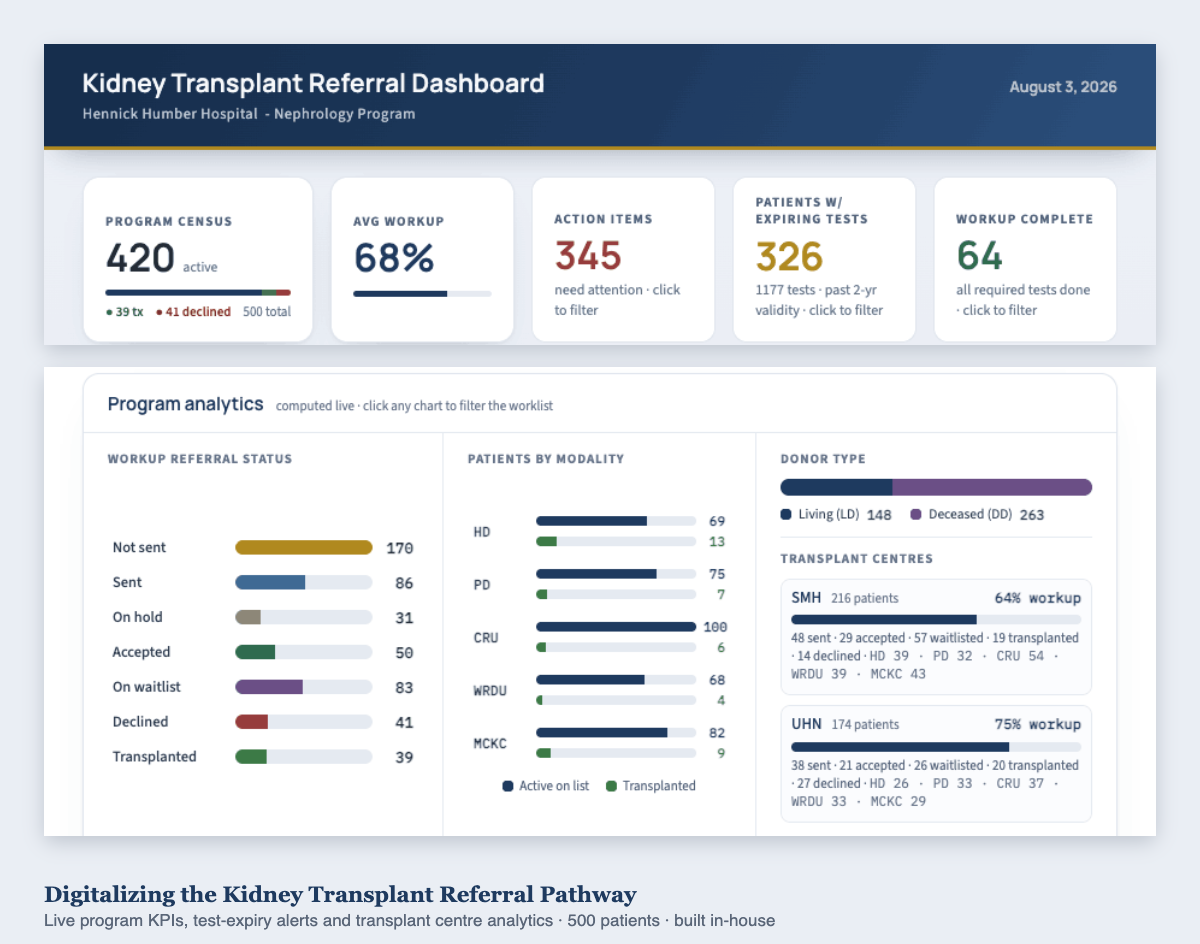
Referrals lived in spreadsheets nobody trusted — tests expired unnoticed, reviews slipped, program statistics took days to assemble. I designed and built one tool: 34 required tests per patient with automatic expiry flags, overdue review alerts, transplant centre routing, and a full program report in one click. Sole designer and developer.
Five pieces of work, and what changed because of them.
Digitalizing the kidney transplant referral pathway
Transplant referrals were tracked across spreadsheets. Required tests expired without anyone noticing, six-month reviews slipped, and pulling program statistics took days of manual counting.
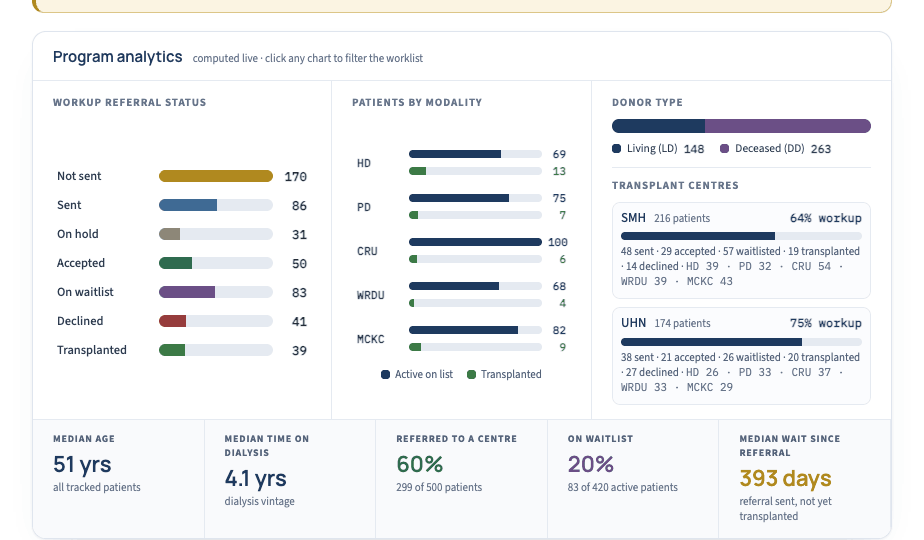
One tool covering the whole pathway: 34 mandatory tests per patient with automatic expiry flags, overdue review alerts, transplant centre routing, centre-requested test tracking, and education status.
Nothing expires silently any more, and a full program statistics report is one click instead of a week. Load-tested at 500+ patients, runs offline so no patient data leaves the hospital.
Kidney Care Clinic flow redesign
A clinic carrying more than 9,000 patients was over-booked and under-utilized at the same time. Cases were reviewed on the day itself, so complex patients ate the schedule and slots went unused.
Mapped the real flow in Visio, benchmarked peer renal programs against Ontario Renal Network standards, and moved case review off clinic day: allied health now review cases together over Zoom the day before, so clinic time goes to the patients who need it.
Clinics now run at full capacity with visits prioritized before the doors open, and a capacity view lets physicians and the manager see demand a week ahead.
Nephrology charter & expansion funding case
The program's activity was real but illegible to people outside it — no shared KPI set, and no analysis Finance could act on.
Co-authored the program charter submitted to the Ontario Renal Network, standardized dialysis registration, and built the volume and funding analysis behind it.
A defined KPI package now reported to leadership and Finance — and the case that supported approval of program expansion funding.
Annual QIP & accreditation dashboards
Improvement targets and accreditation requirements were tracked in separate documents, surfacing only in a retrospective scramble before survey.
Co-designed the annual Quality Improvement Plan, then built dashboards tracking its targets month to month alongside Required Organizational Practices.
Leadership could see whether improvement was holding while there was still time to act on it, not after the fact.
Inpatient falls reduction
Falls were reported and reviewed centrally, so the nurses closest to the risk never saw whether anything they changed made a difference.
Ran PDSA cycles with nursing on the units themselves, with root cause review of each event feeding the next cycle.
Falls per 1,000 patient days on a monthly unit scorecard — the teams owning the measure rather than receiving it.
My route into quality started in the morgue.
In 2021 I was an ICU attendant at Guelph General, and through COVID part of my job was transferring deceased patients to the morgue. It is not the line most people open a portfolio with, but it is the reason I take patient safety personally rather than procedurally.
From there I worked my way through the hospital — bed allocation and patient flow at 7am huddles, medical imaging, dialysis, then clerical and coordination work in nephrology, then patient safety and risk management, and now quality improvement for a renal program. Seven departments, two hospitals, five years.
That route is the whole of my method. I have stood in most of the roles a process touches, so when I redesign one I know where the shortcuts get taken and why. I map what actually happens, not what the policy says, then build the measurement that tells us honestly whether the change held.
Most people at the hospital call me Bobby. I trained as a pharmacist before Canada, which is where the comfort with clinical detail comes from, and studied Healthcare Administration and Service Management at Conestoga. I'm based in Toronto and work at Humber River Health.
"Waste no more time arguing about what a good man should be. Be one."
The person who carried bodies to the morgue is not supposed to be the one building the hospital's dashboards. I intend to keep proving that wrong.
Healthcare decides early who gets to improve it — a title, a credential, a department. I came up through the parts of the hospital nobody puts on a poster, and that is exactly why my process maps are honest and my tools get used. Front-line knowledge and technical capability are not supposed to live in the same person. They should.
So my ambition isn't a tidier annual report. It's to make improvement something a unit can watch move every week, built with the people doing the work, on tools I can build myself instead of waiting two budget cycles for. Quality that runs at the speed of the front line — that's what I'm going after.
Let's talk about the process that's bothering you.
I'm based in Toronto and open to conversations about quality, risk and performance improvement roles across the GTA. Email is the fastest way to reach me.